
In short: Tecar therapy (capacitive-resistive electric transfer) uses radiofrequency energy to warm body tissues. It usually feels like a pleasant warmth, not pain. The evidence is still limited: studies are small, protocols vary and long-term data are missing [1]. The realistic way to see it is as an add-on to manual therapy and exercise, not a stand-alone treatment. Whether it suits you is decided after an assessment by a professional.
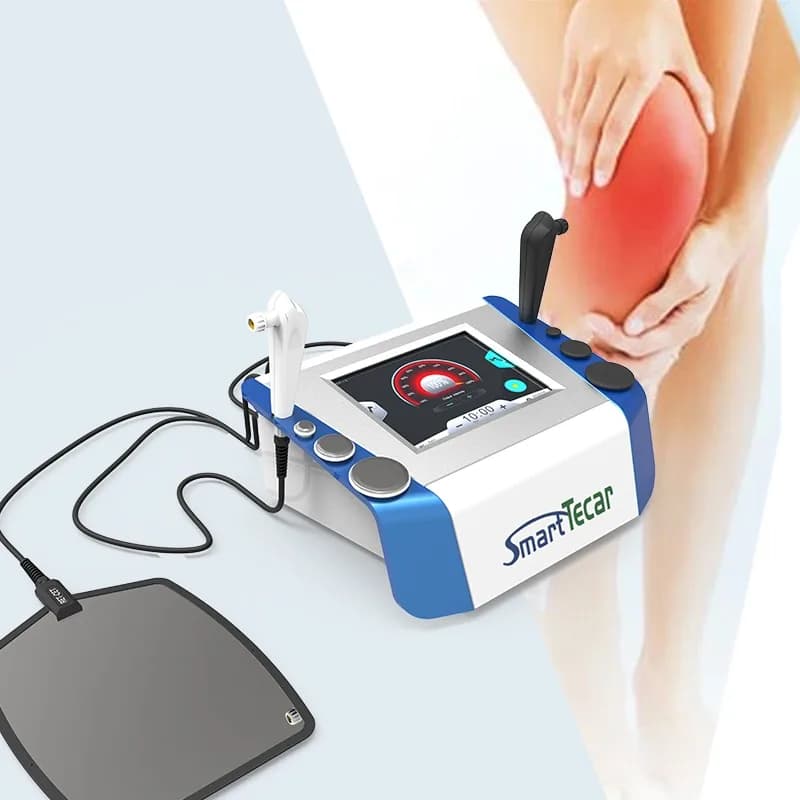
What Tecar therapy is
The name comes from “capacitive and resistive electric transfer”. The device produces a radiofrequency current that passes through the body between an active electrode, which the therapist moves over your skin, and a large plate placed nearby. The result is warming of the tissues, sometimes more superficial and sometimes deeper, depending on the mode used.
- Capacitive mode mainly warms soft tissues with more fluid, such as muscle.
- Resistive mode works deeper, in tissues with higher resistance such as tendons, ligaments or fascia.
The idea is that warming may help muscles relax and support local circulation. How much this matters for recovery is not yet fully clear from the research [1].
What a session feels like
The therapist puts a special cream or gel on your skin, then slowly glides the electrode over the painful area. You sit or lie down, with only the treated area uncovered.
- You feel warmth that builds gradually. It should be tolerable and pleasant, never burning.
- If it gets too hot or you feel prickling, say so straight away. The therapist can lower the power or change technique.
- Afterwards the skin may be slightly red and warm. This usually fades quickly.
At Vertebrick, Tecar is normally combined with other methods such as massage, mobilisation or exercises, rather than used on its own.
What it is used for
In practice, Tecar is often offered for muscle and joint pain, for example:
- back and neck pain with muscle tension;
- tendon problems such as tennis elbow;
- sprains and stiffness after injuries, at the appropriate stage;
- knee or shoulder pain as part of a rehabilitation programme.
It is important to be clear: it is used more widely in practice than the evidence supports. A method being popular does not mean it has been shown to work equally well for all of these problems.
What the studies say so far
A recent clinical commentary by specialists [1] (expert opinion, level 5 evidence, the weakest level) says Tecar may reduce pain and improve range of motion. The authors also stress that studies are small, protocols vary widely and long-term data are missing.
For chronic low back pain, the results are mixed:
- In a randomised trial of 60 adults [2], six sessions over two weeks of manual therapy plus Tecar reduced pain and disability more than manual therapy alone, and the difference was still there at one month. Mobility, however, was not better than with manual therapy alone.
- In another randomised trial of 67 patients [3], with eight sessions over four weeks, all groups improved. Adding Tecar to myofascial release gave no clear extra benefit for pain or disability.
The honest conclusion: Tecar may help some people, especially as an add-on, but we do not yet have solid evidence that it works better than other approaches. We cannot present it as a solution that will work for everyone.
Who should avoid it
Tecar is not for everyone. A doctor or therapist decides whether it is suitable for you after an assessment and after hearing your medical history. In general, extra caution is needed, or treatment is avoided, in these situations:
- a pacemaker or other implanted electronic device;
- pregnancy;
- active cancer or suspected tumour in the area;
- fever, infection or acute inflammation in the treated area;
- thrombosis or significant circulation problems;
- broken or irritated skin, or reduced sensation (you cannot judge heat well);
- metal implants near the treated area.
This list is not complete, so tell your therapist about your conditions, medications and operations before the first session. If back pain comes with warning signs, such as leg weakness, bladder problems or pain after a significant fall, see a doctor first. You can read more in our article on low back pain and its warning signs.
How we approach it in practice
If you decide to try it, a reasonable plan looks like this: an assessment, a clear goal (for example sitting longer at your desk or climbing stairs without pain) and a review after a few sessions to see whether it helps. If you notice no change, there is no point continuing out of habit. Exercise and a gradual return to activity remain the foundation of recovery in most cases. If your elbow hurts, you may also find our article on tennis elbow useful.
Frequently asked questions
Where can I get Tecar therapy in Chișinău?
At Vertebrick, a kinesiotherapy clinic in Chișinău, bd. Traian 12/2. We start with an assessment, and we suggest Tecar only if it makes sense for your situation and there are no reasons to avoid it. You can book online here.
Does Tecar therapy hurt?
Normally not. You should feel a pleasant warmth. If you feel burning or discomfort, say so immediately so the therapist can adjust the intensity.
How many sessions do I need?
There is no single number for everyone. The studies above used 6 sessions over 2 weeks [2] and 8 sessions over 4 weeks [3], but results differ, and your plan depends on your diagnosis and how you respond.
Can it replace exercise?
No. The available evidence looks at Tecar as an add-on to other treatments, not a replacement. Exercise remains an important part of recovery.
Read also: Electrotherapy and ultrasound therapy: what they can and cannot do
Book an assessment
Come in for an assessment at Vertebrick, 12/2 Traian Blvd, Chișinău, Moldova. We are open Monday to Saturday, 08:00–20:00.
📞 +373 69 82 62 12 · WhatsApp: wa.me/37369826212 · Fill in the form
Author: the Vertebrick team, physiotherapy clinic in Chișinău. This article is for information only and does not replace a medical consultation.
Sources
- Lupowitz LG, Ramus L, Delacour F, Johnson K. TECAR therapy: a clinical commentary on its evolution, application, and future in rehabilitation. Int J Sports Phys Ther. 2025. doi:10.26603/001c.130909
- Kasimis K, Iakovidis P, Lytras D, et al. Short-term effects of manual therapy plus capacitive and resistive electric transfer therapy in individuals with chronic non-specific low back pain: a randomized clinical trial. Medicina (Kaunas). 2023. doi:10.3390/medicina59071275
- Zhao P, Lu Z, Zou H, et al. Effectiveness of myofascial release combined with capacitive-resistive therapy in patients with chronic nonspecific low back pain: a randomized controlled trial. Pain Res Manag. 2025. doi:10.1155/prm/9309502