
In short: Electrotherapy (most often TENS) and therapeutic ultrasound have been used in physiotherapy for decades. TENS reduces pain during and right after a session more than a placebo device [1], but the effect depends a lot on how the current is set [2]. The evidence for ultrasound is weak and mixed, so we do not recommend it as a treatment on its own [3]. Both make sense as short-term help alongside exercise and manual therapy.
What electrotherapy (TENS) is
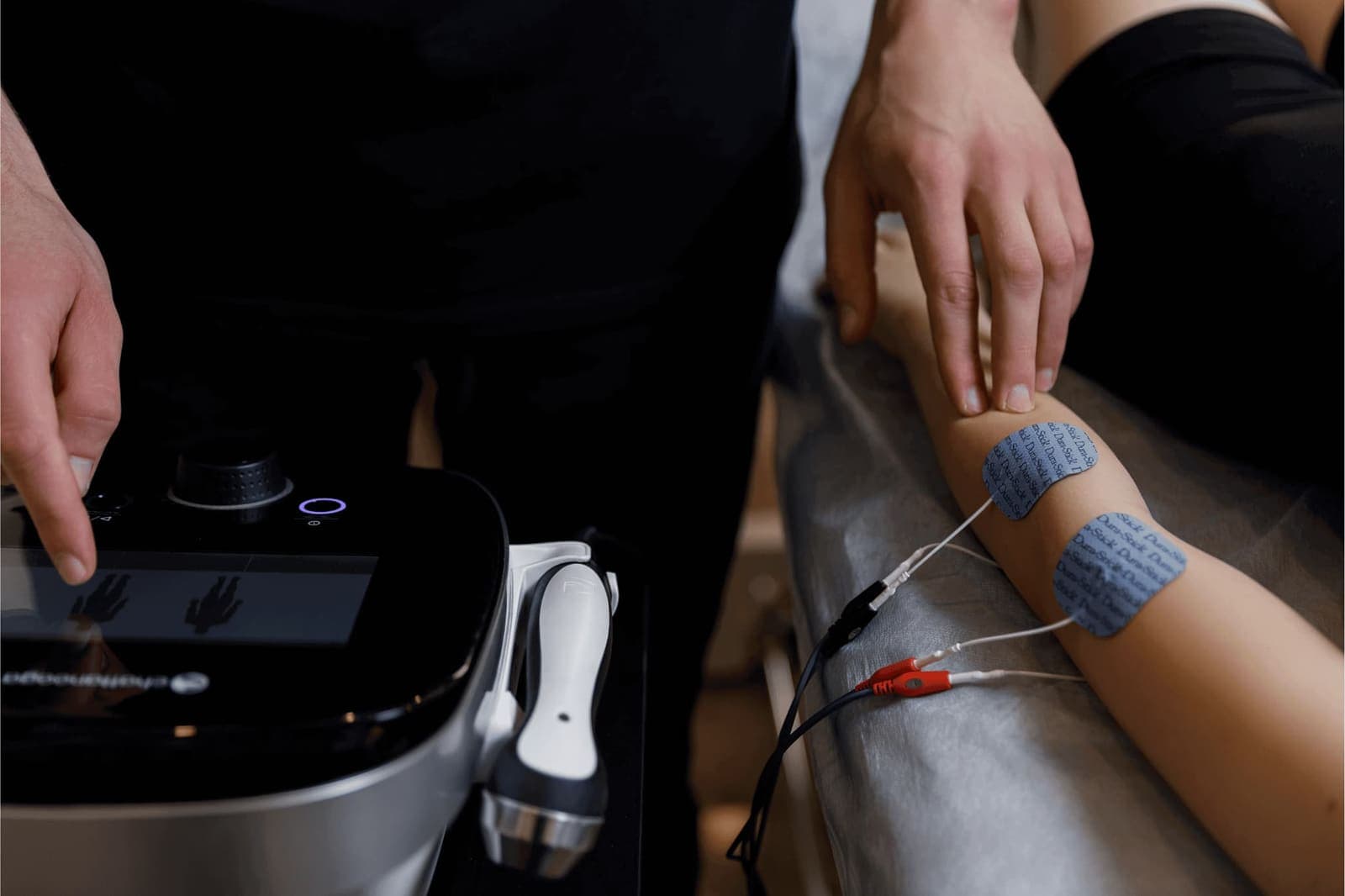
TENS stands for transcutaneous electrical nerve stimulation. Two or four pads are stuck on the skin and the device sends mild electrical pulses. They feel like tingling or buzzing. The idea is that the electrical signal partly "drowns out" the pain signal on its way to the brain and may switch on the body's own pain-relief mechanisms.
There are other kinds of electrotherapy too, such as stimulation that makes a muscle contract (NMES). That is used mainly for weak muscles after surgery or a period in a cast or brace.
What therapeutic ultrasound is
It is not an ultrasound scan. Therapeutic ultrasound sends high-frequency sound waves through a gel from a small head that the therapist moves slowly over the skin. Usually you feel almost nothing, at most mild warmth. The theory is that the waves gently warm the tissue and influence healing, but how much that matters for pain is still unclear [3].
What the research shows
- TENS: an analysis of 381 trials with more than 24,000 people found, with moderate certainty, that pain is lower during and right after TENS than with a fake device. Side effects were rare and mild [1].
- TENS for chronic low back pain: taken all together, the trials show no clear effect. But when the current was strong enough, clearly felt but not painful and without muscle twitching, and was turned up during the session, pain went down. The certainty of this evidence is still low [2].
- Ultrasound for chronic back and neck pain: few trials with mixed results. The authors do not recommend it on its own but say it may help in the short term as part of a wider plan [3].
In plain words: these devices can calm pain, but they do not change its cause by themselves. Strong muscles, mobility and good movement habits are built with exercise.
Why we use them together with exercise
When pain is high, exercise is hard. A session of electrotherapy can bring pain down enough for you to work better straight afterwards. That is how we use it: as a helpful step, not the main treatment. If you have read about Tecar therapy or shockwave therapy, the logic is the same: the device helps, movement does most of the work.
What a session feels like
- TENS: usually 20–30 minutes. The intensity is raised until you clearly feel the tingling, but without pain. If the feeling fades during the session, the therapist turns it up a little, because that adjustment seems to be what matters [2].
- Ultrasound: a few minutes per area. It should not hurt or burn; say so at once if the warmth becomes unpleasant.
Who should avoid them
Tell the specialist before the session if you have a pacemaker or another implanted device, are pregnant (not used over the belly or lower back), have metal implants in the area, active cancer, a blood clot, epilepsy, a wound or skin problem where the pads would go, or reduced skin sensation. In these cases a doctor or the specialist decides whether the method suits you and where it can be used.
Frequently asked questions
How many sessions will I need?
TENS helps mainly during and just after the session, so there is no fixed course. We use it for as long as pain gets in the way of your exercises.
Can I buy a TENS device for home?
Yes, small home devices exist. It is worth learning first from a specialist where to place the pads and what intensity to use, and checking that nothing rules it out for you.
Where can I get electrotherapy in Chișinău?
At Vertebrick, bd. Traian 12/2. After an assessment we decide whether electrotherapy or ultrasound makes sense for you and combine it with exercise. You can book online. For back pain, see also our article on low back pain.
Book an assessment
Come in for an assessment at Vertebrick, 12/2 Traian Blvd, Chișinău, Moldova. We are open Monday to Saturday, 08:00–20:00.
📞 +373 69 82 62 12 · WhatsApp: wa.me/37369826212 · Fill in the form
Author: the Vertebrick team, physiotherapy clinic in Chișinău. This article is for information only and does not replace a medical consultation.
Sources
- Johnson MI, Paley CA, Jones G, Mulvey MR, Wittkopf PG. Efficacy and safety of transcutaneous electrical nerve stimulation (TENS) for acute and chronic pain in adults: a systematic review and meta-analysis of 381 studies (the meta-TENS study). BMJ Open. 2022. doi:10.1136/bmjopen-2021-051073
- Amer-Cuenca JJ, Lisón JF, Ferrer-Sargues FJ, et al. Dose-response effects of transcutaneous electrical nerve stimulation for chronic low back pain: a systematic review and meta-analysis. Eur J Pain. 2026. doi:10.1002/ejp.70222
- Noori SA, Rasheed A, Aiyer R, et al. Therapeutic ultrasound for pain management in chronic low back pain and chronic neck pain: a systematic review. Pain Med. 2020. doi:10.1093/pm/pny287