
In short: Kinesio tape is an elastic tape, often brightly coloured, stuck directly onto the skin. Studies suggest it may reduce pain a little and improve function in the short term, especially in low back pain [1]. The difference compared with placebo tape is small, though. Tape does not replace exercise and does not treat the cause of the pain. Whether it suits you is decided after an assessment by a specialist.
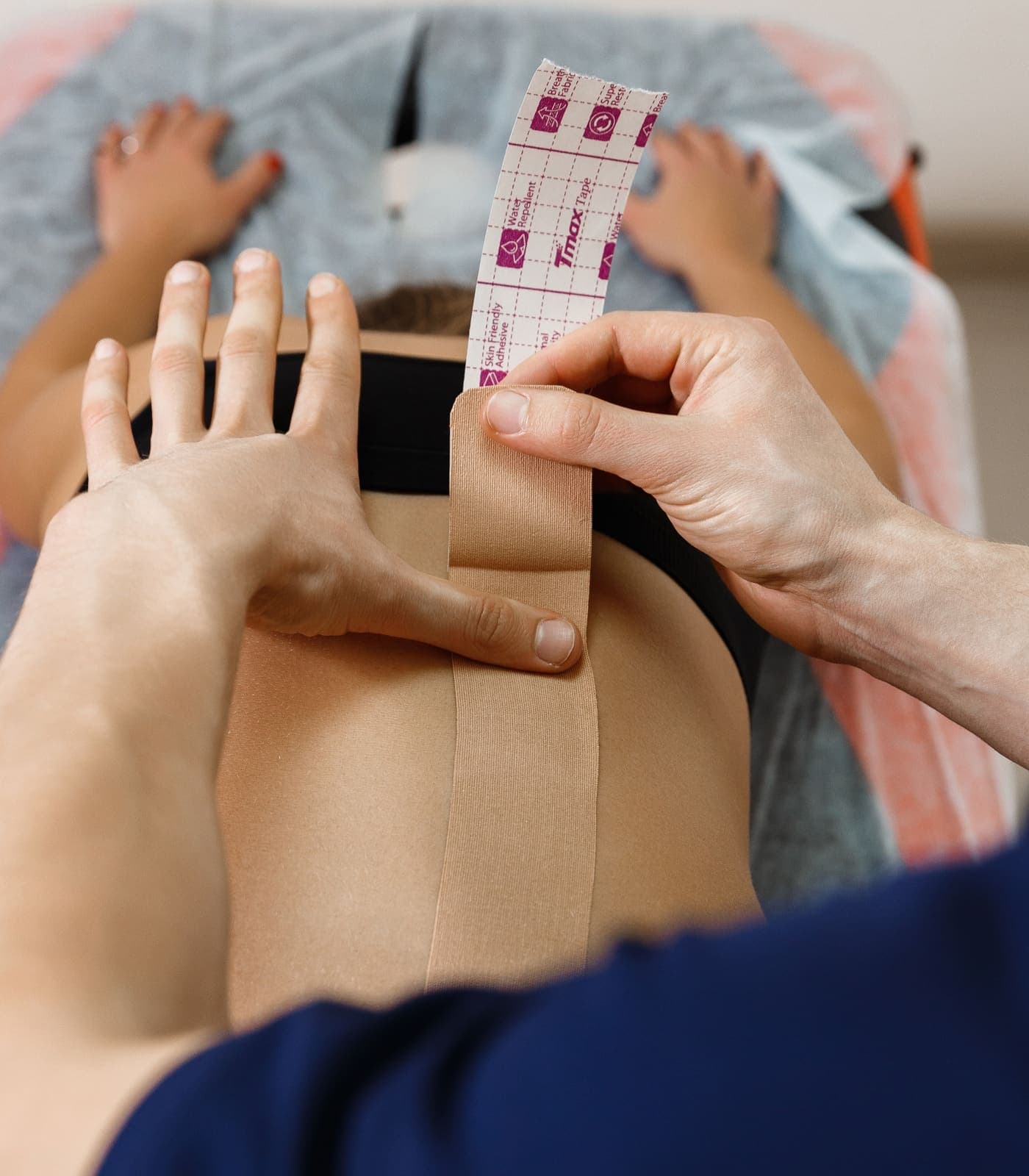
What kinesio tape is and what it does
It is a stretchy cotton or synthetic tape with adhesive on one side. You see it a lot on athletes, but it is also used for back, knee and shoulder pain. The colour makes no difference to the effect. What matters is how well it is applied and whether it makes sense for your problem.
How it works is still debated. One idea is that the tape stimulates the skin and changes the feeling around a joint or muscle, so movement feels easier. There is not enough evidence for claims such as "drains the tissues" or "corrects the fascia", so we do not promise that.
What the studies say
We rely on three reviews of studies, to be honest about what is known and what is not:
- Low back pain: an analysis of 54 randomised trials with 3479 people found that tape may reduce pain and improve function in the short term, including in pregnancy. The difference compared with placebo tape is small, there is little long-term evidence, and tape was not better than physiotherapy [1].
- Pain at the front of the knee: in 10 low-quality trials, tape added to rehabilitation slightly reduced pain. It did not change strength, range of motion or joint position sense [2].
- Chronic shoulder pain: in 14 studies with 862 people, adding kinesio tape to physiotherapy gave no extra benefit for shoulder mobility [3].
The practical conclusion: tape can be a small, short-term helper alongside exercise and activity. It is not a stand-alone treatment.
Who it may help
After an assessment, tape may be considered, for example:
- in low back pain, as a temporary aid to move more easily, including in pregnancy (read about causes, warning signs and what helps in low back pain);
- in pain at the front of the knee, together with exercises (see our article on patellofemoral pain);
- when the tape works as a reminder of your posture or movement during exercises or daily activities.
Who should not have tape is decided at the assessment by a doctor or specialist. For example, they will look carefully at broken or irritated skin, allergy to adhesive, very fragile skin, or swelling or pain in a leg with no clear cause. Tell your therapist if you have ever reacted to sticking plasters.
How long it stays on
Usually a few days. The exact time depends on your skin, sweating, the body area and how active you are, and your therapist will tell you when applying it. You can shower. Afterwards, pat the tape dry with a towel without rubbing, and avoid hot air from a hairdryer. If the edges lift, you can trim them with scissors. If it has come off almost completely, do not stick it back on.
Do not keep it on "as long as possible" just because it does not bother you. The longer it stays, the higher the chance of irritation.
Skin care
- Apply it to clean, dry skin, with no cream or oil that day.
- Take the tape off and tell your therapist if you get strong itching, redness, burning, blisters or more pain.
- Do not rip it off. Hold the skin with one hand and peel the tape back slowly, almost parallel to the skin. If it sticks hard, soften it with oil or lukewarm water.
- After removal, let the skin rest and moisturise it with a simple cream.
- Do not apply tape over wounds, burns, eczema or cracked skin.
The limits of kinesio tape
Tape cannot fix a disc herniation, "put a joint back in place", or replace the strength and control you build with exercise. The effect compared with placebo is small [1], and in some cases, such as shoulder mobility, it added nothing to physiotherapy [3]. See a doctor if pain travels down the leg, or if you have numbness, weakness, fever or bladder problems, or if the pain began after a heavy blow. For pain running down the leg you can also read about sciatica.
Frequently asked questions
Can I shower and exercise with the tape on?
Showering is fine, then pat the tape dry gently. For sport, ask your therapist, because sweat and friction can loosen the tape sooner.
Can tape replace exercises?
No. In the studies reviewed, tape was not better than physiotherapy [1] and was usually used as an add-on to rehabilitation [2][3]. Exercise remains the foundation.
Can I apply it myself at home?
You can, but it helps to be assessed first. Tape applied wrongly does not help and may irritate the skin. Ask to be shown the technique and how long to wear it.
Where can I get kinesio tape in Chișinău?
At Vertebrick, bd. Traian 12/2, Chișinău. The kinesiotherapist assesses you first, then decides whether tape makes sense in your case and can include it in an exercise programme. You can book online: book an appointment.

Book an assessment
Come in for an assessment at Vertebrick, 12/2 Traian Blvd, Chișinău, Moldova. We are open Monday to Saturday, 08:00–20:00.
📞 +373 69 82 62 12 · WhatsApp: wa.me/37369826212 · Fill in the form
Author: the Vertebrick team, physiotherapy clinic in Chișinău. This article is for information only and does not replace a medical consultation.
Sources
- Inostroza-Quiroz J, Solano-López R, Bascour-Sandoval C, et al. Effectiveness of kinesio tape in people with low back pain. A systematic review with meta-analysis. Eur J Phys Rehabil Med. 2026. doi:10.23736/s1973-9087.26.09064-7
- Jiao H, Tao M, Cui X. Efficacy on pain and knee function of Kinesio taping among patients with patellofemoral pain syndrome: a systematic review and meta-analysis. BMC Musculoskelet Disord. 2025. doi:10.1186/s12891-025-08627-7
- Yang F, Li X, Wang J, et al. Efficacy of different analgesic strategies combined with conventional physiotherapy program for treating chronic shoulder pain: a systematic review and network meta-analysis. J Orthop Surg Res. 2024. doi:10.1186/s13018-024-05037-8