
In short: A bunion (hallux valgus) forms when the big toe leans towards the other toes and a bump sticks out at its base. Exercises can reduce pain and slightly improve the toe's position, but they do not return the foot to a normal shape [1]. The right shoes matter a lot. If pain limits walking despite these measures, an orthopaedic surgeon may discuss surgery, which corrects the angle well [2]. Rehab after surgery is important, although there are still few studies on it [3].
Why bunions form
- Genes: they often run in families.
- Shoes that are narrow, pointed or high-heeled can speed it up and make it worse.
- Foot mechanics: flat feet or very mobile joints; see our article on flat feet.
Bunions are much more common in women.
What exercises and spacers can and cannot do
In a study of 82 women, 12 weeks of exercise reduced pain and slightly reduced the big-toe angle, but the angle stayed larger than in a normal foot. Adding kinesio tape or a splint gave no extra benefit, and the long-term effect was not studied [1].
Toe spacers can make walking more comfortable, but they do not "straighten" the bone. Be sceptical of products that promise that.
How to ease the pain
- shoes with a wide, deep toe box, a soft sole and no high heel;
- protective pads over the rubbing spot;
- insoles if you also have flat feet or pain under the toes;
- exercises for the big toe and the muscles of the sole;
- a short ice pack after a long day on your feet.
Simple exercises
- Toe spreading: try to move the big toe inwards, away from the others, without lifting the foot.
- "Short foot": gently lift the arch with the toes relaxed on the floor.
- Heel raises with the weight over the big toe.
- Big-toe mobility: move it up and down with your hand.
When surgery is discussed
Surgery makes sense when pain limits walking or wearing shoes despite the measures above, not just for looks. A large review found that operations correct the big-toe angle by about 19 degrees on average and improve foot function [2]. The type of operation is the surgeon's decision.
After surgery, walking with weight on the foot early, as the surgeon allows, and exercises for the toe and ankle seem to help, but the evidence is limited [3]. A physiotherapist helps you get back to normal walking step by step.
Frequently asked questions
Do bunions always hurt?
No. Many people have bunions without pain. We treat pain and function, not the X-ray.
Can a bunion come back after surgery?
Sometimes, yes. Good shoes and exercise help keep the result.
Where can I get bunion rehab in Chișinău?
At Vertebrick, bd. Traian 12/2, before or after surgery. You can book online. For heel pain, see plantar fasciitis.
Book an assessment
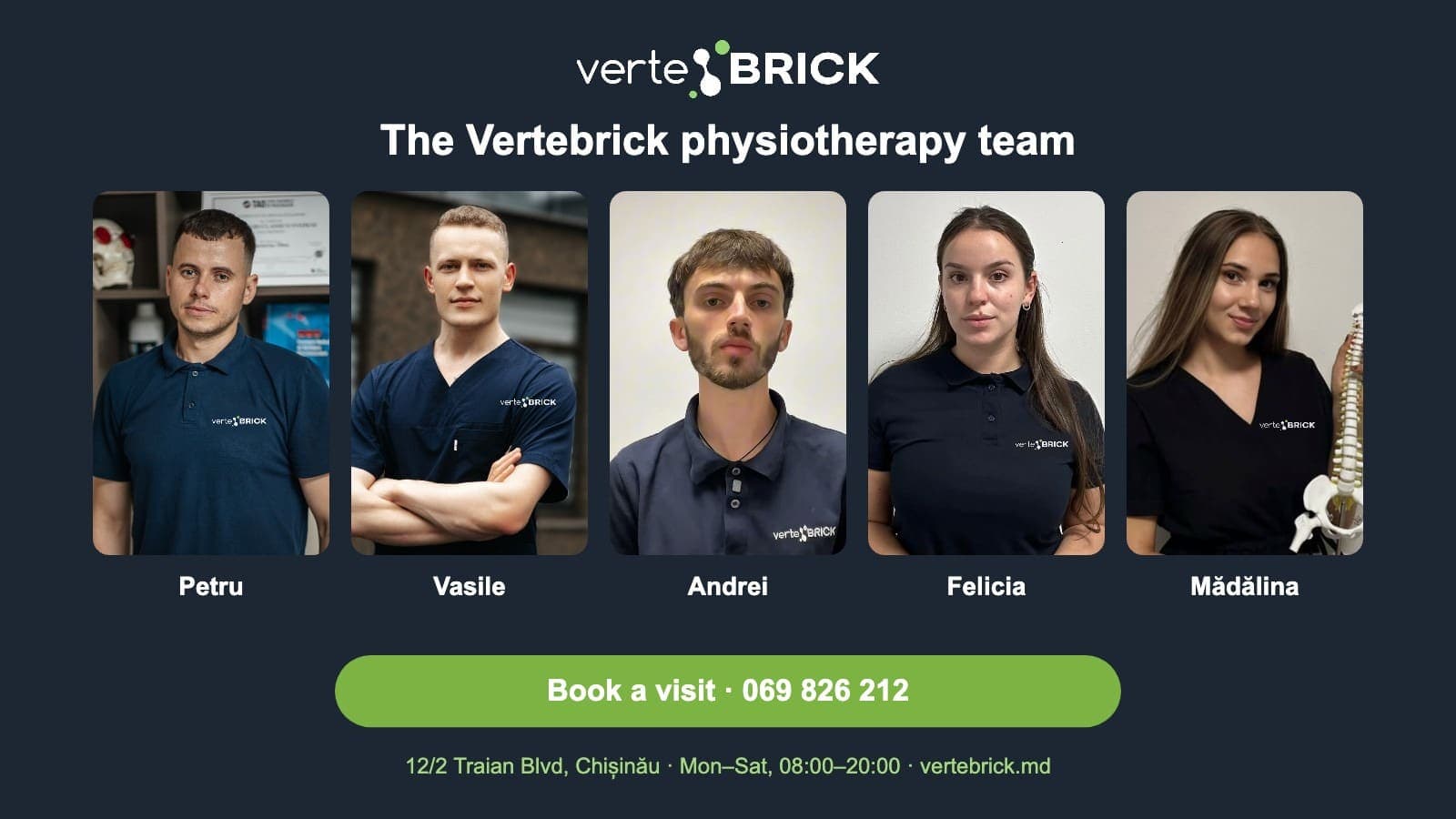
Come in for an assessment at Vertebrick, 12/2 Traian Blvd, Chișinău, Moldova. We are open Monday to Saturday, 08:00–20:00.
📞 +373 69 82 62 12 · WhatsApp: wa.me/37369826212 · Fill in the form
Author: the Vertebrick team, physiotherapy clinic in Chișinău. This article is for information only and does not replace a medical consultation.
Sources
- Jankowicz-Szymańska A, Wódka K, Smoła E, Bibro MA. The impact of corrective exercises, kinesiology taping, and mechanical correction on pain and foot shape in women with hallux valgus. Front Physiol. 2025. doi:10.3389/fphys.2025.1473278
- Ettinger S, Spindler FT, Savli M, et al. Correction potential and outcome of various surgical procedures for hallux valgus surgery: a living systematic review and meta-analysis. Arch Orthop Trauma Surg. 2024. doi:10.1007/s00402-024-05521-0
- Gumuskaya O, Peterson B, Donnelly H, et al. Preoperative and postoperative physical and mechanical rehabilitation interventions in hallux valgus: a systematic review. J Foot Ankle Res. 2025. doi:10.1002/jfa2.70083